
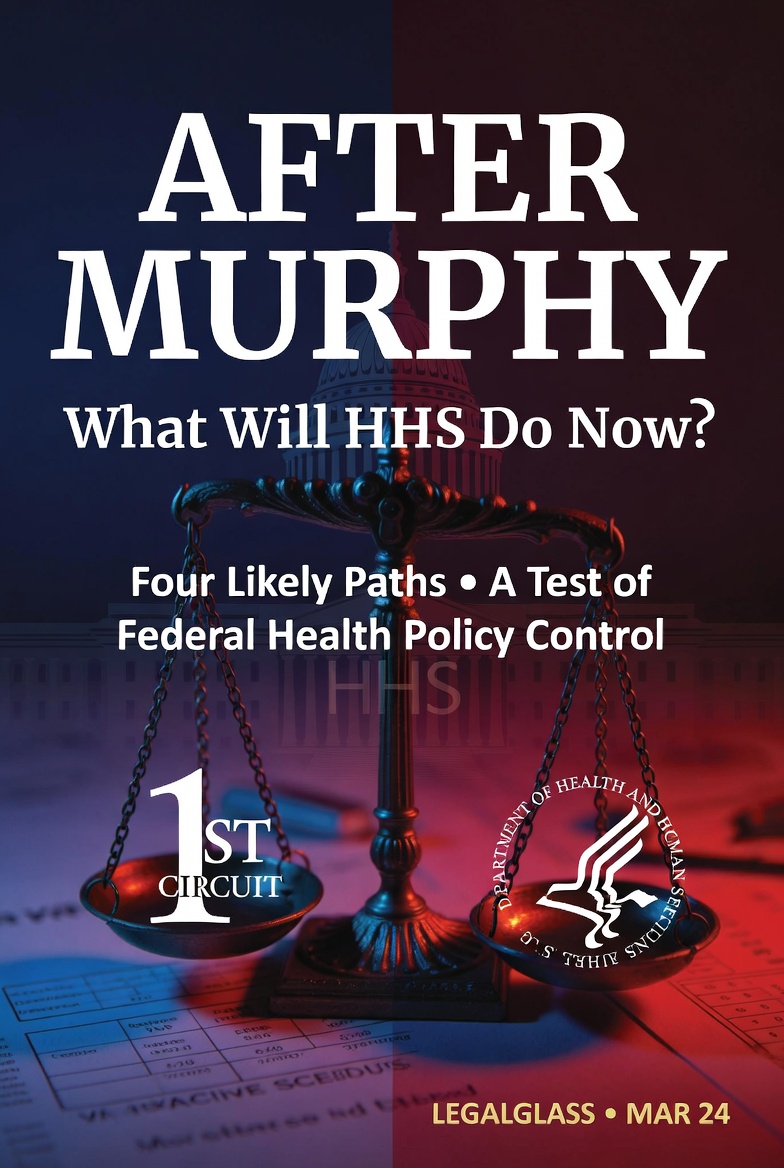
republished with permission from The Legal Glass Substack
In the wake of the recent American Academy of Pediatrics v. Kennedy ruling by Judge Brian E. Murphy—which halted the CDC’s revised childhood vaccine schedule and invalidated both the membership and prior votes of HHS’s reconstituted Advisory Committee on Immunization Practices (ACIP)—a wide range of observers are asking the same question: what happens next?
The urgency is understandable. As a practical matter, the decision has brought federal health policymaking to a standstill. Until the stay is lifted or reversed, the CDC is effectively frozen. ACIP, as currently constituted, cannot meet. Workgroups cannot be convened. New recommendations cannot be issued, even in response to evolving data or seasonal needs. Under the court’s framework, the CDC Director cannot change vaccine recommendations without ACIP involvement, and ACIP cannot act. The result is not just a pause in one policy, but a halt to the agency’s ability to update, revise, or respond at all. That reality is unlikely to remain tolerable for long—even for those who favor the prior system and view this ruling as a win.
Speculation has already filled the vacuum. Social media posts briefly circulated claiming that HHS had “disbanded” ACIP and would not appeal, only to be walked back as premature. Others suggest the agency may instead defend the existing committee by supplementing the record. The signal, at least for now, is noise.
HHS has not yet announced its next move. But the stakes are significant, and the available paths forward are increasingly clear.
This is not simply a dispute over vaccines. It is a dispute over who controls the machinery of federal policymaking.
HHS Still Holds the Authority
Before turning to the most likely paths forward, it is critical to reset the baseline.
The authority to make federal public health policy comes from Congress, primarily through the Public Health Service Act. That authority is vested in the Secretary of Health and Human Services and exercised through agencies such as the CDC. Advisory bodies like ACIP exist to assist in that function, but they are not the source of it.
ACIP is not a constitutional entity or a universal statutory prerequisite. It is an advisory committee created by HHS under the framework of the Federal Advisory Committee Act (FACA), which sets general rules for federal advisory bodies. ACIP exists to serve HHS’s advisory needs—its role is to provide recommendations, not to dictate outcomes or control agency authority.
Because HHS retains ultimate policymaking authority, it also retains control over how it structures advisory input. It can revise ACIP’s charter, redefine the expertise it seeks, appoint new members, or replace the committee entirely. Its authority does not rise or fall with ACIP. A court ruling cannot transfer that policymaking authority to the judiciary.
The Court’s Framing of Its Decision
Judge Murphy appears to recognize these limits, framing his opinion as a matter of process rather than substance. Although certain footnotes suggest a view that aligns with the plaintiffs’ position on changes to CDC vaccination policy, the decision itself does not purport to evaluate whether the revised vaccine schedule—or the prior votes of the reconstituted ACIP—were sound. Instead, Murphy concludes that the process used to adopt these policies was legally deficient.
Specifically, the court asserts that ACIP was effectively required to be involved in changes to the CDC’s childhood immunization schedule. It further concludes that the committee itself was not “fairly balanced” under FACA and was therefore “tainted” from the outset. On that basis, the court invalidates both ACIP’s composition and its prior actions, and stays the CDC’s adoption of changes moving several vaccines into shared clinical decision-making.
A more detailed analysis of the ruling is available in my prior post HERE: https://legalglass.substack.com/p/boston-activist-judge-decides-he
The key point is this: the court claims to object to the process, not the policy itself. That distinction now governs what HHS can do next. The four likely paths forward are outlined below.
Path 1: Reconstitute ACIP and Move Forward
The most direct approach would be to take the court at its word. If the defect is procedural—either lack of ACIP involvement or lack of “fair balance”—then HHS can cure that defect and proceed.
That would begin with amending the ACIP charter, if necessary. These revisions could redefine ACIP’s “function”—for example, to include not only clinical and epidemiological considerations but also risk-benefit analysis and broader population health factors—as well as expand the range of relevant expertise and appoint new members consistent with that framework. Once constituted, the new ACIP could consider vaccine policy questions—including whether to adopt the same recommendations issued by acting CDC Director Jim O’Neill in January 2026, or some version thereof—through the ordinary advisory process of notice, public meeting, deliberation, and vote, followed by CDC Director action.
This process need not take years. A revised charter can be drafted quickly, members appointed within days, and meetings scheduled on an expedited basis. The key point is not timing, but that the process is documented, transparent, and consistent with the agency’s stated criteria.
Proceeding in this manner would not place HHS back before Judge Murphy in the first instance. Instead, plaintiffs would need to file a new motion for emergency relief—not a contempt motion, absent defiance of the existing order—because a newly constituted ACIP would represent a new agency action rather than use of the stayed committee. The court would then have to reassess the traditional factors—likelihood of success on the merits, irreparable harm, and the balance of equities—in light of a cured process.
That challenge is almost certain—and the same judge would likely hear it. The question then becomes: if the defect has been cured, what remains of the court’s objection?
Murphy’s opinion emphasizes ACIP’s “function” and the requirement that it be “fairly balanced,” while also pointing to historical practices such as extended vetting and outreach. That framing suggests he may attempt to fault a quickly reconstituted committee or claim insufficient outreach.
As a matter of law, however, neither FACA nor any other statute imposes a minimum timeline for forming an advisory committee, and past practice does not create binding requirements. While the court may scrutinize composition, its authority is limited. If HHS defines a broader conception of ACIP’s “function” and the relevant expertise—such as clinicians, epidemiologists, economists, and risk analysts—it is within its discretion to do so. FACA requires balance in light of function, and that function is defined by the agency.
Path 2: Defend the Existing ACIP
A second option is to defend the current committee rather than rebuild it. Under this approach, HHS, through DOJ, would supplement the record to address weaknesses in its original presentation—potentially amending the charter and providing detailed declarations outlining each member’s qualifications and perspectives.
There is reason to believe the original record was incomplete. Commentators, including stayed-ACIP Vice Chair Dr. Robert Malone, have noted that the government relied on general references rather than individualized explanations, and Judge Murphy himself acknowledged in a footnote that he may not have had a complete picture of the members’ qualifications. That leaves room for a more robust evidentiary submission.
HHS could then move to lift the stay, arguing that the committee, properly understood, is “fairly balanced.”
This approach is faster and preserves continuity, including the work of a committee that many view as engaging more openly with evidentiary gaps and risk considerations. But it carries a critical limitation: it places HHS squarely back before Judge Murphy, asking him to reconsider his own ruling. Unlike Path 1, this approach depends entirely on the court’s willingness to change course.
Even with a stronger record, HHS would be asking Murphy to revisit conclusions he has already reached. If his view of relevant expertise remains unchanged, additional documentation may not alter the outcome.
At that point, the issue shifts from evidentiary sufficiency to the scope of judicial authority. The composition of an advisory committee is an agency determination. FACA requires balance in light of function, but it does not authorize courts to dictate that function or impose a preferred model of expertise. If a supplemented record is still rejected, the question becomes whether the court is evaluating the agency’s explanation or substituting its own judgment.
Path 3: Appeal to the First Circuit—and Beyond
The third path is to take the issue out of the district court. HHS could seek an emergency stay and appeal to the First Circuit, arguing that the decision misapplies FACA and the APA and intrudes on the agency’s policymaking authority.
On an emergency basis, appellate courts can act on an accelerated schedule—often within days or weeks—depending on the urgency and posture of the case. If affirmed, the matter would likely proceed to the Supreme Court on an emergency application, where review can also occur on a similarly compressed timeline. In practice, the appellate path can move relatively quickly, though timing remains inherently unpredictable.
The difference is consequence. An appeal does not simply resolve this case—it defines the limits of judicial review. If affirmed, the ruling risks expanding FACA and allowing courts greater control over agency processes. If reversed, it reinforces the proper boundary between judicial review and agency decision-making.
This is why many view an appeal as not just advisable, but necessary. The concern is not just this policy, but whether courts can invalidate advisory bodies and effectively halt agency action under the guise of process review, based on requirements not grounded in statutory text. The Supreme Court has signaled skepticism toward expansive injunctions that disrupt executive operations, and the practical effect here extends nationwide. Whether that framework is permitted to stand is a question that likely cannot—and should not—remain at the district court level.
Path 4: The Dual Track Option
A final option may offer the best of both worlds: HHS could pursue an appeal while simultaneously reconstituting ACIP and curing the alleged procedural defect.
Under this approach, the agency does not wait for the courts to resolve the legal question. It preserves its position on appeal—challenging the ruling’s interpretation of FACA and the limits of judicial authority—while also restoring its ability to act by building a new, defensible advisory process in parallel. If the appeal succeeds, HHS secures a broader legal ruling clarifying its authority; if not, the agency is already positioned to proceed under a revised process.
This strategy maximizes flexibility and minimizes delay, allowing HHS to address both immediate operational constraints and longer-term institutional stakes.
Running parallel tracks requires coordination to ensure consistency between the agency’s litigation posture and administrative record. But there is no requirement that HHS pause its policymaking authority while a court reviews a prior action—particularly where it is curing the defects the court identified.
Conclusion
The path HHS chooses will likely become clear in the coming weeks, and with it, whether this ruling is a temporary disruption or the start of a fundamental shift in who controls federal health policy.
The Constitution does not assign federal health policy to district court judges. That authority remains with the executive branch, subject to lawful limits, not judicial substitution.
What matters now is how quickly that authority will be exercised to confront this overreach, and whether courts will enforce the limits of their role when the issue returns to them.
Rita is a medical freedom attorney and former law school professor who now writes on a variety of medical freedom issues. A former FNF board member, Rita was also part of the legal team at FLTJ, the firm that represented Free Now Foundation in lawsuits against K-12 Covid mandates and prolonged states of emergency. You can follow more of Rita’s work at: https://legalglass.substack.com/







0 Comments