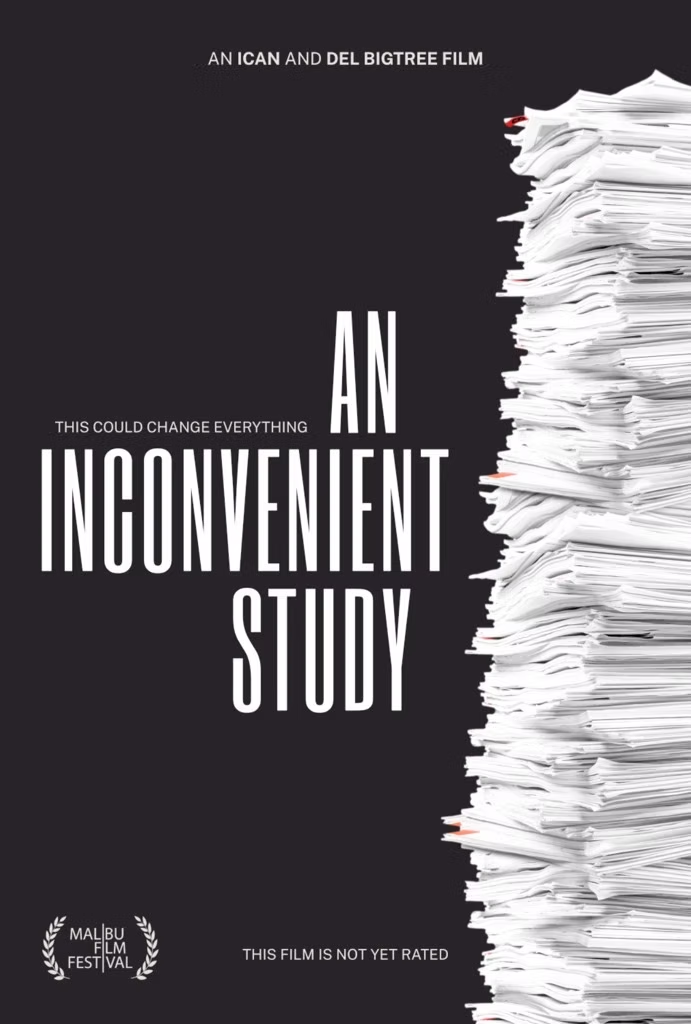
An Inconvenient Study, which just won Best Film at the Malibu Film Festival, is more than a documentary. It’s a mirror held up to a system that prefers marketing over medicine and narrative over nuance — and it’s sparking debate in medical and policy circles across the country.
The film centers on what may be the largest vaccinated vs. unvaccinated study ever conducted, tracking over 18,000 children over a ten-year period within the Henry Ford Health System. According to the data, unvaccinated children were found to be significantly healthier than their vaccinated counterparts — a finding that challenges mainstream assumptions about vaccine safety and public health.
But here’s the twist: the study was never published.
Why?
That depends on who you ask.
The study’s author, Marcus Zervos, a leading infectious disease expert, in a secretly-recorded conversation with filmmaker Del Bigtree, assures Del that the methodology and results are sound and valid.
The filmmakers — and ICAN (Informed Consent Action Network), whose lead attorney Aaron Siri first brought the study to light during recent U.S. Senate hearings — argue that the study’s suppression was intentional, because the results were too inconvenient for the medical-industrial complex to digest. From this perspective, the film paints a damning picture of institutional censorship and scientific gatekeeping.
Henry Ford Health, on the other hand when pressed to publish it, now publicly claims the study was methodologically flawed. In a cease-and-desist letter, they argue that the unvaccinated sample size was small, and the two groups were not properly matched. According to their statement, the unvaccinated children in the study were disproportionately white, male, born with fewer complications, and came from different socioeconomic backgrounds — making it, in their words, “an apples-to-oranges comparison.”
However, a re-analysis controlled for the fewer office visits among the unvaccinated. It verified the overall results.
Fair enough. Scientific rigor and methodological integrity matter. But the deeper question — and the one this film dares to ask — is why these kinds of studies are so rare to begin with. If the data was flawed, why not publish and debate it transparently? Why bury it?
The origin of the study is just as compelling as its findings. In 2016, journalist and The HighWire host Del Bigtree publicly challenged Zervos to conduct a gold-standard vaccinated vs. unvaccinated study. He accepted — reportedly confident it would debunk Bigtree’s claims. The result? A study that supports, rather than contradicts, what many parents and practitioners in the medical freedom movement have observed anecdotally for years: unvaccinated children often have lower rates of chronic illness.
The film masterfully weaves hidden camera footage, archival documents, and expert testimony to expose not just a buried study, but a deeper crisis: the erosion of trust in public health. It challenges the viewer to reconsider what “science” really means when open inquiry is punished, when dissent is silenced, and when data is only valid if it reinforces the dominant narrative.
Free Now Foundation, believes that informed consent is a cornerstone of ethical medicine, and we see documentaries like An Inconvenient Study to be both heartbreaking and vindicating. Heartbreaking because it confirms that uncomfortable truths are often buried to protect institutional power. Vindicating because it shows that despite censorship, the truth does have a way of surfacing — even if it arrives through leaked documents and a film festival screening, rather than a peer-reviewed journal.
If science is only allowed to speak when it says what power wants to hear, then we are no longer practicing science — we are managing perception.
This film invites us to think again, to read the study, and most importantly, to ask the questions we were told not to ask.
And that’s not just inconvenient — it’s revolutionary.
Free Now Foundation plans to screen An Inconvenient Study soon in various locations. Stay tuned.
Aria Morgan is a writer and advocate dedicated to civil liberties, medical freedom, and free speech. As Director of Content at Free Now Foundation (2024–2026) and former Managing Editor of Children’s Health Defense–CA (2021–2024), she helped shape investigative storytelling efforts advancing informed consent and individual rights.
Aria bridges more than 30 years of embodied wellness practice and over 25 years of teaching with civic engagement. Her wellness work lives at DailyDowndog.com


EVERY person should watch this film.