
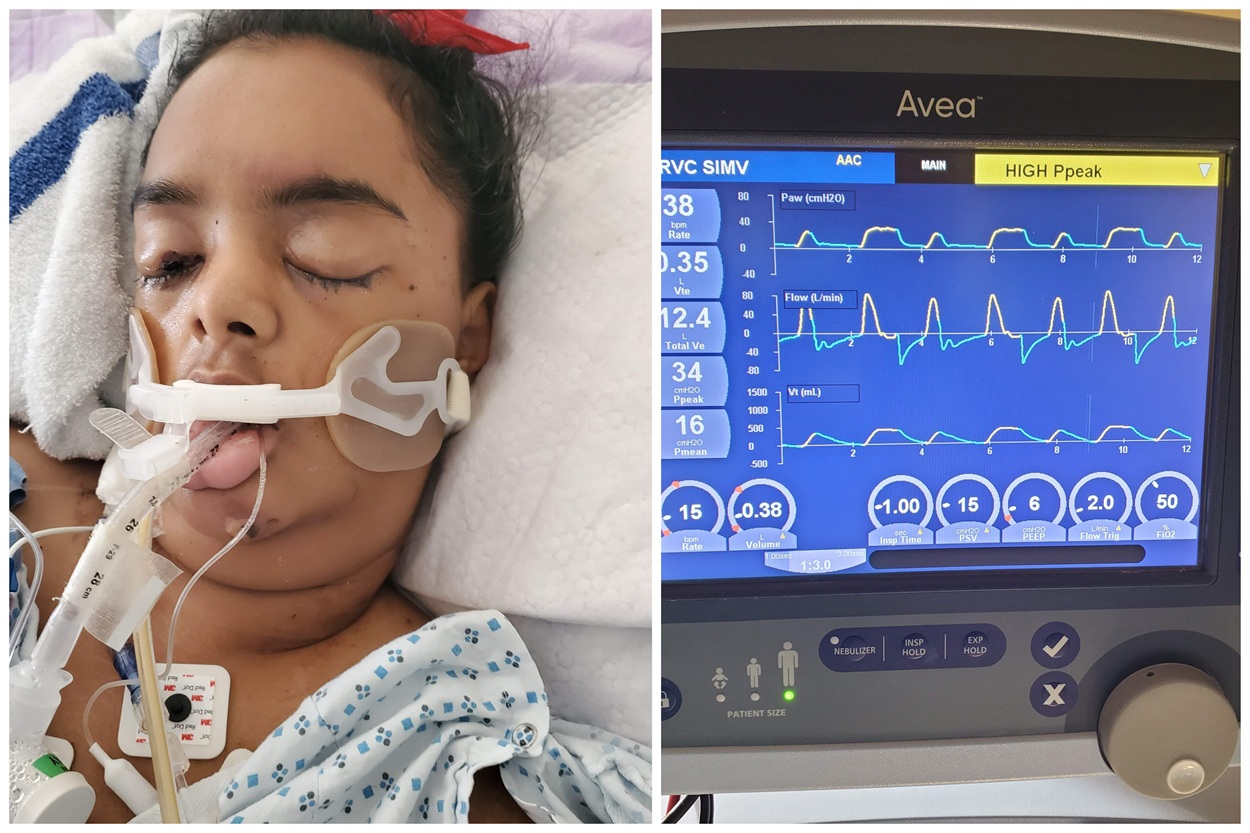
Editor’s Note: What happened to Danielle and millions of others must stop. Free Now Foundation is funding Attorney Tricia Lindsay who is readying a lawsuit to seek justice for Danielle and put an end to the practice of using deadly hospital protocols with impunity. To support this ground-breaking case and let Rebecca and other grieving parents know how important this issue is to you, please put “Danielle” or “Rebecca” in the tribute area in checkout.
There is a particular sound a ventilator makes at night.
Not loud.
Not urgent.
Just steady. Mechanical. Certain.
In the beginning, Rebecca tried to trust that sound.
Her daughter Danielle had entered the hospital on August 27, 2021, with no fever. A clear chest. Oxygen around 93%. A normal white blood cell count.
Rebecca would later write: “Despite normal vital signs… she was misdiagnosed.” But in those early days, she did not yet have that language.
She had trust.
Rebecca had merely brought her daughter to the hospital to be checked for a persistent cough.
Danielle was immediately subjected to wanton polypharmacy – Northwell Hospital treated her like a guinea pig for drugs.
After only four days of hospitalization, Rebecca was told her mentally-challenged young adult daughter Danielle would need ventilation.
Rebecca never consented to her daughter being placed on a ventilator. She was told her daughter had Covid pneumonia and was in acute hypoxic respiratory failure. She had been told there was concern for sepsis, and there was a need for ventilation and for Danielle to be placed in ICU. The words arrived wrapped in clinical certainty. Charts glowed. Numbers blinked. Staff moved with controlled urgency.
The ventilator was presented not as escalation — but as protection.
And at the center of that room stood the figure Rebecca would come to understand as the real authority in Danielle’s final days.
Not the hospital system.
Not the building.
Not even the diagnosis.
The Ventilator Maestro.
He did not need to raise his voice.
He did not need to persuade.
The ventilator obeyed him. The sedation followed him. The numbers confirmed him.
When Rebecca asked questions, she was told Danielle was “very sick.”
When she asked about alternatives, she was told this was “standard protocol.”
When she hesitated, she felt the shift — subtle but unmistakable — from mother to obstacle.
In her sworn affirmation, Rebecca describes what followed as “a 40-day course of negligent treatment.” But what she experienced, in real time, felt like something else:
A slow transfer of authority.
Remdesivir — not for five days, but ten.
Tocilizumab, a monoclonal antibody used during Covid to calm a “cytokine storm.”
Fentanyl — infusion, IV push, transdermal patch.
Each decision framed as necessary.
Each increase described as protective.
Each objection absorbed into the hum of machinery.
Rebecca was Danielle’s legal guardian and medical proxy. She had the right to consent. She had the right to refuse. Yet she later wrote that treatments were administered “without my consent as her medical proxy and legal guardian.”
Consent did not disappear dramatically. It thinned.
Conversations became updates.
Updates became conclusions.
Conclusions became irreversible.
And the Maestro continued conducting.
A System of Clinical Authority
Hero and anti-hero stories rarely announce themselves.
The anti-hero does not wear menace.
He wears credentials.
He references oxygen saturation curves.
He references compliance ratios.
He references intubation timing.
He speaks in numbers that seem indisputable.
When arrhythmias appeared on the monitor, Rebecca remembers asking if something was wrong.
She remembers the word myocardial spoken calmly.
She remembers feeling that the room understood something she was not being told.
Later, medical records would show heart arrhythmias and a myocardial infarction. Later, a toxicology report would reveal 53 ng/mL of fentanyl — twice what is widely considered lethal. Later, an autopsy would confirm right ventricle heart failure.
But in the ICU, there was no autopsy. There was only sedation.
Layered. Persistent. Silencing.
Rebecca would later describe it as a “deadly cocktail.”
In the moment, it felt like watching her daughter grow farther away while standing inches from her bed.
The Last Embrace
And yet Danielle was still Danielle.
One afternoon, she needed to use the bathroom. She could not manage a bedpan. A nurse escorted her — helped her stand, helped her walk.
Later, that nurse approached Rebecca.
“She wouldn’t let me go,” the nurse said. “She hugged me so tight.”
Danielle clung to her.
Not because she understood toxicology reports.
Not because she knew about ventilator settings.
But because Danielle used to love giving hugs, and she hadn’t had any touch in days. She needed warmth, the comfort of another human being.
Rebecca replays that image constantly — her daughter, sedated, restrained at times, still reaching for human contact.
Inside a system governed by protocol, Danielle still recognized safety.
And she held onto it.
Patterns
Rebecca began to notice patterns.
She began writing down dates.
September 5.
September 12.
September 26.
October 3.
She began connecting shifts. Noticing who was present during escalations. Watching the ventilator settings change. Watching fentanyl continue.
In her legal affidavit, she states plainly: “Danielle was restrained, denied an advocate, and left to suffer.”
The Maestro did not see restraint as cruelty: instead, he regarded it as compliance, just as he regarded sedation as management.
And Rebecca began to understand that what she was fighting was not a single error — but a culture of escalation where questioning authority was reframed as ignorance.
She was the emotional one.
The grieving one.
The mother.
But grief is not confusion.
Love is not incompetence.
And guardianship is not decorative.
October 6, 2021– The Silence After the Machines
There are days that fracture time.
October 6 began like the others — fluorescent light, antiseptic air, the steady mechanical breath of the ventilator. Rebecca had learned the rhythms by then. She knew the cadence of oxygen alarms. She knew which tones meant adjustment and which meant escalation.
She had started sleeping in intervals. Thinking in monitor readings. Measuring hope in small, incremental numbers.
That morning, something felt different.
She would later describe it not as panic — but as intuition. Danielle had been quieter. The sedation deeper. The responses slower. There is a point at which sedation stops looking therapeutic and begins to look like disappearance.
Rebecca remembers standing beside the bed and watching her daughter’s chest rise — not on its own, but on command.
She remembers touching Danielle’s arm and whispering her name.
She remembers the ventilator answering instead.
When the arrhythmias began, they appeared first as flickers. Numbers dipping, rising, dipping again. Rebecca asked what they meant. She asked if Danielle was having a heart issue.
She was told they were “monitoring it.”
She was told it was “common in critical illness.”
She was told not to worry.
Then the tone of the room changed.
It is subtle when it happens. Staff move faster. Voices lower. Instructions sharpen.
Rebecca remembers someone saying “myocardial infarction.”
She remembers looking at Danielle’s face — pale, still, tubes threaded where her daughter’s laughter once lived.
She remembers thinking, This is not what we came here for.
The ventilator continued its steady breath.
The Maestro adjusted settings.
Orders were given. Medications administered. The choreography of critical care unfolded around her — precise, technical, practiced.
And then, despite all of it, Danielle’s heart failed.
The machines that had hummed for forty days fell into a different rhythm. A code. A sequence. Hands pressing. Voices counting.
Rebecca does not describe chaos.
She describes a narrowing.
A tunnel of sound.
A mother watching professionals work on a body that still, impossibly, felt like her child.
At some point, the music stopped.
The ventilator no longer conducted.
There is a silence in an ICU after a death that feels heavier than noise.
Rebecca stood inside that silence.
Not screaming.
Not collapsing.
Witnessing.
Later, she would write: “Danielle tragically died on October 6, 2021… due to what I believe was egregious medical negligence.”
But on that day, there were no affidavits.
Only a mother touching her daughter’s hand, still warm.
Only the awareness — sharp and undeniable — that something human had gone wrong.
From Machines to Motions
Grief is immediate.
Accountability is slow.
After the funeral, after the casseroles stop arriving, after the house becomes unbearably quiet — the machines are gone.
But the records remain.
Rebecca began asking for them.
Medical records. Medication logs. Shift schedules. Toxicology reports. Autopsy findings.
At first, it felt like reopening a wound.
Then it became something else.
Documentation.
The toxicology report confirmed 53 ng/mL of fentanyl in Danielle’s system — twice what is widely recognized as lethal.
The autopsy confirmed right ventricle heart failure.
Medication logs reflected Remdesivir administered for ten days. Tocilizumab. Continuous fentanyl — infusion, IV push, transdermal patch.
Dates aligned.
September 5.
September 12.
September 26.
October 3.
Names aligned with shifts.
The Ventilator Maestro was no longer just a presence in a dim ICU room. He became the dispenser of unnecessary and lethal medical actions. His recommendations became entries on a schedule. Orders in a chart. Signatures beneath dosage authorizations.
Paper does what memory cannot.
It freezes decisions in time.
Rebecca filed her complaint on April 5, 2024.
She did so pro se.
She did so as a grieving mother.
She did so as Danielle’s legal guardian and executor of her estate.
“I filed this action to hold the Defendants accountable,” she wrote.
Not because litigation is healing.
But because silence is permission.
The hospital framed its actions as standard of care. As protocol. As crisis medicine during extraordinary times.
Rebecca frames them differently.
As escalation without informed consent.
As sedation without collaboration.
As authority that eclipsed guardianship.
The Maestro conducted oxygen.
Rebecca now conducts evidence.
Affirmations. Motions. Replies. Schedules. Toxicology.
Each page is quieter than a ventilator.
But far more permanent.
This is not spectacle.
This is correction.
Rebecca is not asking for applause.
She is asking for review.
For judicial scrutiny.
For the system that trusted machines over mothers to be examined under oath.
The ventilator stopped on October 6.
The paper trail did not.
And in the absence of machinery, it is the only thing still speaking for Danielle.
Free Now Foundation has stepped up to fund this lawsuit.
———–/
Editor’s Note: What happened to Danielle and millions of others must stop. Free Now Foundation is funding Attorney Tricia Lindsay who is readying a lawsuit to seek justice for Danielle and put an end to the practice of using deadly hospital protocols with impunity. To support this ground-breaking case and let Rebecca and other grieving parents know how important this issue is to you, please put “Danielle” or “Rebecca” in the tribute area in checkout.
Read Part 1 of Danielle’s story here.
Aria Morgan is a writer and advocate dedicated to civil liberties, medical freedom, and free speech. As Director of Content at Free Now Foundation (2024–2026) and former Managing Editor of Children’s Health Defense–CA (2021–2024), she helped shape investigative storytelling efforts advancing informed consent and individual rights.
Aria bridges more than 30 years of embodied wellness practice and over 25 years of teaching with civic engagement. Her wellness work lives at DailyDowndog.com



This author has been able to provide pure visual of what this dear mother experienced.
As a nurse for decades I see what she saw. Common sense and critical thinking skills along with education has been replaced with protocols. These protocols don’t leave any room for adjustments, unless you have a strong advocate that speaks out.
God give her strength in pursuing righting this wrong.
Justice and accountability for Danielle. I’m sad for what Danielle and her mom have been through. In 2024 during a 41 day hospitalization I was heavily over medicated & wrongly medicated with pharmaceuticals not meant for me. I’m lucky I survived it all. Over drugging, wrong drugging is the #1 cause of death in the USA.
It has been stated by alternative doctors and hospital staffs who have formerly assisted in the sort of care Danielle experienced from conventional medicine to never allow a patient to be put on a ventilator in a hospital. They are usually turned too high, which ends up being why, together with all those dangerous drugs are why such patients die. The Medical Industrial Complex doesn’t believe in the simple Ivermectin that has two types, human and animal, and continues to lie about that. This doesn’t mean all those who worked in the hospital helped murder Danielle. Only those at the top, the hospital administrator, doctor, and specialists in the protocol did that. Do not ever check into just any hospital. Find out now where Dr. Johnson recommends sending a gravely sick person in your area now so you will know.
This strikes a nerve, a scream for the poor souls who were sent to their graves. For what? Hopefully, in this case, Danielle will receive justice. I’m here by the grace of God after being admitted to a hospital in 2021 for COVID. I presented with difficulty breathing. The admitting physician informed me that if I went “upstairs,” I’d never get out. For 4 days, nurses injected me with Remdesivir. Our son contacted Doctors Without Borders, learned what the ultimate effects would be for me. 2x/day, he called to have me released. Finally, on the 4th evening, they unhooked me, and my daughter brought me home. By that time, I was extremely ill (I was 83 years old), and my family believed the worst. I’m here through a caring, professional doctor who operates outside the larger establishment. My health renewed, faith not in the larger scheme of medical care, but in the medical professionals who believe the Hippocratic Oath means something.
I have heard of an elderly patient with covid being admitted to a hospital with pneumonia during the height of the pandemic. He was started on the same protocol as Danielle despite his and his family’s objections. His request for Ivermectin was refused. It was refused. They sedated him and put him on a ventilator. The family ended up having to get a judge involved to force the hospital to discharge him. I cannot remember if he survived the ordeal or not. I do not know where this happened. In a different case, the family saw the covid protocol being initiated, remdesivir, monoclonal antibody and managed to him leave the hospital. As a retired RN, these stories have caused me to loose trust in our health care system. I am glad that Danielle’s mother is suing the hospital that treated her daughter like a guinea pig and caused her death. They need to be held accountable. Unfortunately, these same protocols are still mandated by law when patients are admitted with covid pneumonia. At least hospitals are no longer paid for each patient who dies of covid like they did during the pandemic.